QualitySoldering guidelines
Soldering guidelines
Recommended Pb-free reflow, wave and hand soldering profiles for SSO packages, and what to avoid when attaching a device to a board.
Introduction
Reflow soldering is the most common way of attaching Solid State Optronics (SSO) devices to PCBs. Recommendations for reflow and other means of component attachment to PCBs appear below. For more details on soldering methods, reference Application Note 103 (PDF).
Reflow Soldering
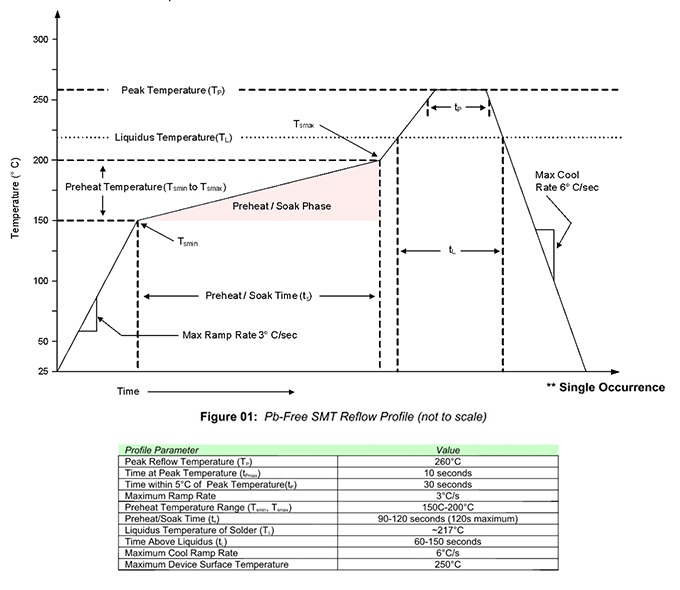
The process of reflow soldering passes a PCB assembly through an oven where solder paste is heated, reflows, and bonds the joint between component leads and PCB contact pads. The assembly is then cooled completing the process. The following figure and table show SSO recommendations for reflow profiles.
| Profile parameter | Value |
|---|---|
| Peak Reflow Temperature (TP) | 260°C |
| Time at Peak Temperature (tPmax) | 10 seconds |
| Time within 5°C of Peak Temperature (tP) | 30 seconds |
| Maximum Ramp Rate | 3°C/s |
| Preheat Temperature Range (Tsmin, Tsmax) | 150°C–200°C |
| Preheat/Soak Time (ts) | 90–120 seconds (120s maximum) |
| Liquidus Temperature of Solder (TL) | ~217°C |
| Time Above Liquidus (tL) | 60–150 seconds |
| Maximum Cool Ramp Rate | 6°C/s |
| Maximum Device Surface Temperature | 250°C |
Wave Soldering
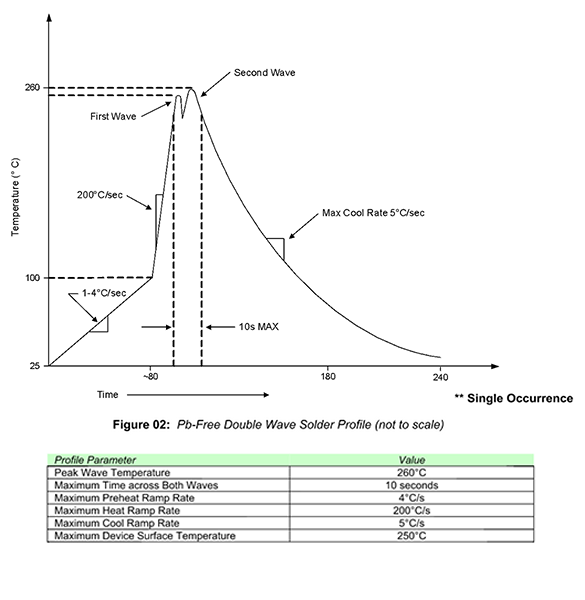
In wave soldering a conveyor moves the circuit board assembly over waves of molten solder causing joints between the solder pads and component leads. The following figure and table show SSO recommendations for a typical wave solder profile.
| Profile parameter | Value |
|---|---|
| Peak Wave Temperature | 260°C |
| Maximum Time across Both Waves | 10 seconds |
| Maximum Preheat Ramp Rate | 4°C/s |
| Maximum Heat Ramp Rate | 200°C/s |
| Maximum Cool Ramp Rate | 5°C/s |
| Maximum Device Surface Temperature | 250°C |
Hand (Manual) Soldering
This is a manual process using a soldering iron. It requires a fairly high level of skill and dexterity, is time-intensive and is typically suited to prototype or short run builds.
If used, this soldering method comes with the following SSO recommendations:
- Maximum Temperature: 350°C (at iron tip)
- Maximum Time: 3s
SSO devices should undergo the manual solder process only a single time.